

Do You Need Planning Permission for Loft Boarding in Liverpool?
For most houses in Liverpool, no. Boarding a loft for storage does not need a planning application, and it does not need formal Building Regulations approval, as long as you are not turning the space into a room.
That is the short answer. The longer one is worth reading, because loft boarding and a loft conversion are easy to mix up, and Liverpool has a few property types where the rules are less straightforward.
Boarding is not a conversion
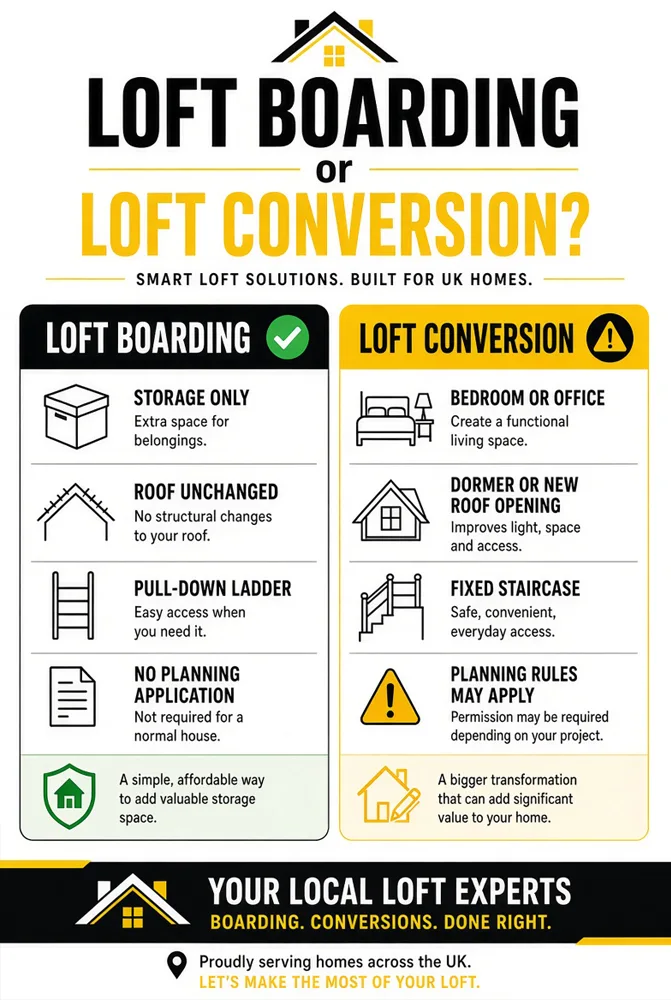
Planning permission is about changes that affect the outside of a building, or a change in how it is used. A storage floor inside an existing loft does neither of those things. The roof stays the same. You are not adding a dormer, raising the ridge, or putting in a window. You are not creating a bedroom, office or playroom.
That is why loft boarding in Liverpool usually sits outside the planning system. You do not apply to Liverpool City Council, and you do not need a permitted-development certificate for a normal storage job.
A loft conversion is different. That is habitable space. It can still fall under permitted development in many houses, but only within limits on volume, height and the look of the roof. If it does not meet those limits, it needs a full application. Boarding for suitcases and decorations is not that project.
When you should check before you start
There are a few situations where it is sensible to ask first.
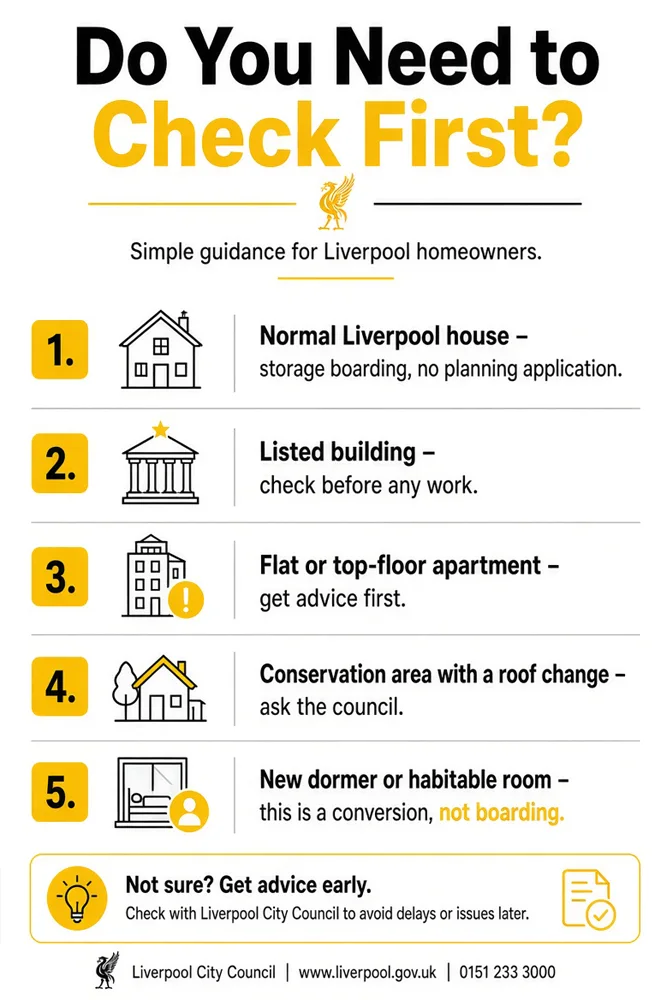
Listed buildings are the clearest one. Internal work in a listed house can need listed building consent even when an ordinary house would not need planning permission. Liverpool has listed homes in older streets, including parts of Woolton, Aigburth and the city centre. If the house is listed, do not assume boarding is automatically fine.
Conservation areas are a softer case. Storage boarding that does not change the roof is still normally acceptable, but Article 4 directions can remove permitted development rights on some streets. If you are in a conservation area and the job involves any external change, check with the council. Boarding alone, with no new opening in the roof, rarely falls into that category.
Flats are another exception. The usual householder rules do not apply in the same way to a flat or a building that contains flats. Most city-centre apartments do not have a loft to board anyway. If you own a top-floor flat with access to a roof space, get advice before any work starts. The space may not be yours to alter.
What Building Regulations ask for
No formal application is not the same as no rules.
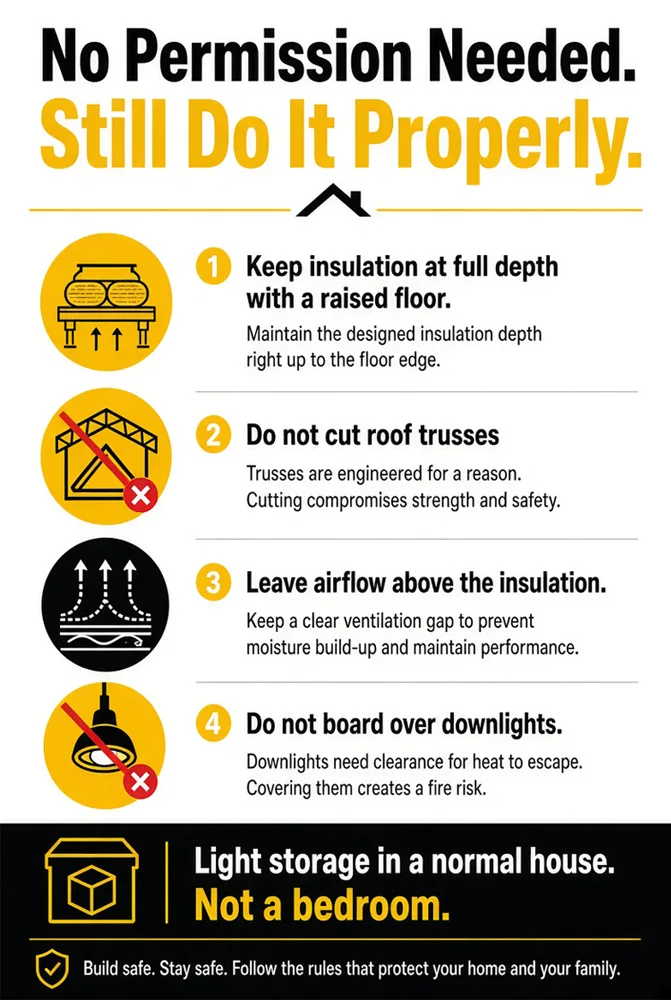
Ceiling joists are there to hold the ceiling up, and to allow someone up for maintenance. They are not a floor for a bedroom. Light storage, spread across a proper platform, is a different load from a habitable room. That is why a raised boarding system is used: it spreads weight and lifts the floor above the insulation.
Current guidance for loft insulation in England is a depth of about 270mm of mineral wool. If boards sit on the joists and squash that layer, the roof performs worse than it was designed to. In a newer Liverpool house that can also sit badly with the standard the builder signed off. A raised floor avoids that.
A few other practical points matter more than people expect. Do not cut or remove roof trusses to make space. Do not lay boards over recessed lights in the ceiling below. Keep some airflow above the insulation, or condensation becomes the next problem. Leave access to tanks, wiring and the eaves.
None of that usually means a Building Control visit. It does mean the job should be done as storage, not as a half-finished room.
How this shows up in Liverpool houses
In a 1930s semi in Childwall, West Derby or Aintree, boarding for storage is almost always a straightforward internal job. The question is the loft itself, not the council.
In a Victorian terrace in Wavertree, Walton or Anfield, the same planning position applies. The practical limits are height, hatch size and joist condition, not permission.
In a newer house in Speke, Fazakerley or on the edge of Croxteth, permission is still not the issue. Insulation depth is. Those lofts were built with a thick thermal layer. The floor needs to sit above it.
A simple way to tell which job you are planning
If the roof looks the same from the street, the ladder pulls down, and the space is for storage, you are boarding. In a normal Liverpool house, that does not need planning permission.
If you want to sleep up there, work up there, or change the outside of the roof, you are converting. That is a different set of rules, and a different cost.
This is general guidance, not a formal planning opinion. Listed buildings, flats and any job that changes the roof should be checked with Liverpool City Council or a planning consultant before work starts.
If you only need the storage floor, we can look at the loft and say what it can take. Call Ryan on 07873 269 573 or email Allaboveboardstorage@gmail.com.
Do You Need Planning Permission for Loft Boarding in Liverpool? – FAQ
Do I need planning permission to board my loft in Liverpool?
Not for normal storage boarding in a house. You are not changing the roof or creating a habitable room.
Does loft boarding need Building Regulations approval?
A formal application is not usually required for light storage, provided you do not alter the structure. The installation should still protect insulation, avoid overloading the joists, and leave ventilation and services clear.
Is loft boarding the same as a loft conversion?
No. Boarding is storage. A conversion is living space, and it has extra rules on structure, fire safety, stairs and often the outside of the roof.
What if my Liverpool house is listed?
Check before you start. Listed building consent can apply to internal work even when planning permission would not.
What if I live in a conservation area?
Storage boarding with no external change is still normally fine. If the roof will change, or the street has extra restrictions, ask the council first.
Can I use a boarded loft as a bedroom?
No. Once it is slept in or used as a room, it is being treated as habitable space, and conversion rules apply.
Ready to Board Your New Build Loft Safely?
If you want to create storage in your new-build loft without affecting your NHBC warranty, we’re here to help.
Call Ryan on 07873 269 573
or email Allaboveboardstorage@gmail.com to book a free, no-obligation survey.
We’ll assess your loft, confirm the best compliant solution, and provide a clear quote with no pressure.